Product description
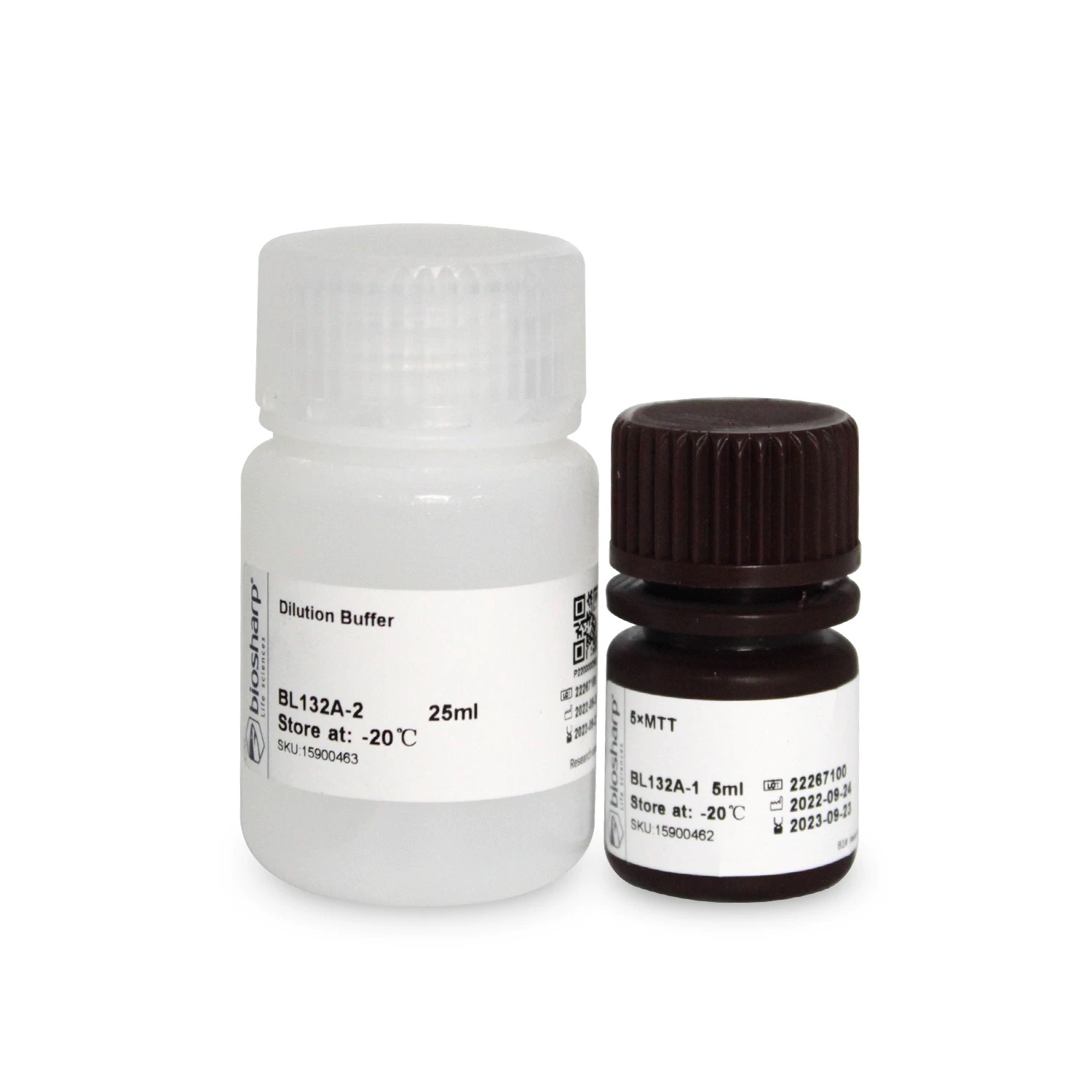
Product Name: MTT [3-(4,5-Dimethylthiazol-2-yl)-2,5-diphenyltetrazolium bromide] Cell Proliferation and Cytotoxicity Assay Kit
Key Features and Specifications
| Feature Category | Specification |
| Assay Principle | Colorimetric Assay based on the reduction of a tetrazolium dye |
| Target | Mitochondrial Dehydrogenase Activity (A marker for viable, metabolically active cells) |
| Detection Wavelength | 570 nm (Used with a UV-Vis Spectrophotometer) |
| Readout | Absorbance (Directly proportional to the number of viable cells) |
| Kit Contents | MTT Reagent (Tetrazolium salt solution) and Solubilization Solution (e.g., DMSO, acidified isopropanol) |
| Assay Time | Short incubation time (Typically 2–4 hours) |
| Key Advantage | Simple, Reliable, and High-Throughput measurement of cell viability and drug toxicity |
Product Summary
The MTT Assay Kit is a foundational and widely accepted tool in the Biochemical / Life Sciences and pharmacology fields for quantifying cell proliferation and assessing cytotoxicity (cell death) in response to external stimuli, such as therapeutic drugs, toxic compounds, or novel material extracts.
The assay is based on the ability of metabolically active cells to convert the yellow MTT tetrazolium salt into purple-colored, water-insoluble formazan crystals. This reaction is catalyzed by mitochondrial dehydrogenase enzymes. The intensity of the resulting purple color, measured by a UV-Vis Spectrophotometer, is directly proportional to the number of viable cells in the culture well, providing a reliable measure of cell health and growth.
Primary Applications
Drug Discovery & Pharmacology:
IC₅₀ Determination: Precisely calculating the concentration of a test compound required to inhibit cell growth by 50%.
Cytotoxicity Screening: High-throughput screening of large libraries of compounds to identify potential anti-cancer agents or toxic compounds.
Biomaterials & Tissue Engineering:
Biocompatibility Testing: Evaluating the toxicity of new polymers, nanoparticles, or scaffold materials by assessing their effect on cell viability and metabolism.
Fundamental Cell Biology:
Cell Growth Curves: Monitoring the proliferation rate of various cell lines under different culture conditions (e.g., varying nutrient levels or growth factors).
Apoptosis/Necrosis Studies: A primary tool for measuring the gross reduction in viable cells resulting from induced cell death pathways.
Assay Principle in Detail
The yellow MTT salt is added directly to the cell culture medium. Viable cells internalize the dye. Inside the cell, the mitochondrial dehydrogenase enzyme cleaves the tetrazolium ring, resulting in the formation of the purple formazan crystals. These crystals are insoluble and must be dissolved using the Solubilization Solution before the optical density (absorbance) can be measured. The final absorbance value is then used to quantify the cell viability relative to untreated control cells.
Ordering and Convenience
Ready-to-Use: The kit contains pre-optimized reagents, simplifying the protocol and minimizing preparation time.
Compatibility: Designed for use with standard 96-well and 384-well plates, making it fully compatible with automated liquid handling and plate-reading systems for high-throughput screening.
Sensitivity: Provides a highly sensitive and linear measurement across a broad range of cell numbers.