
Product description
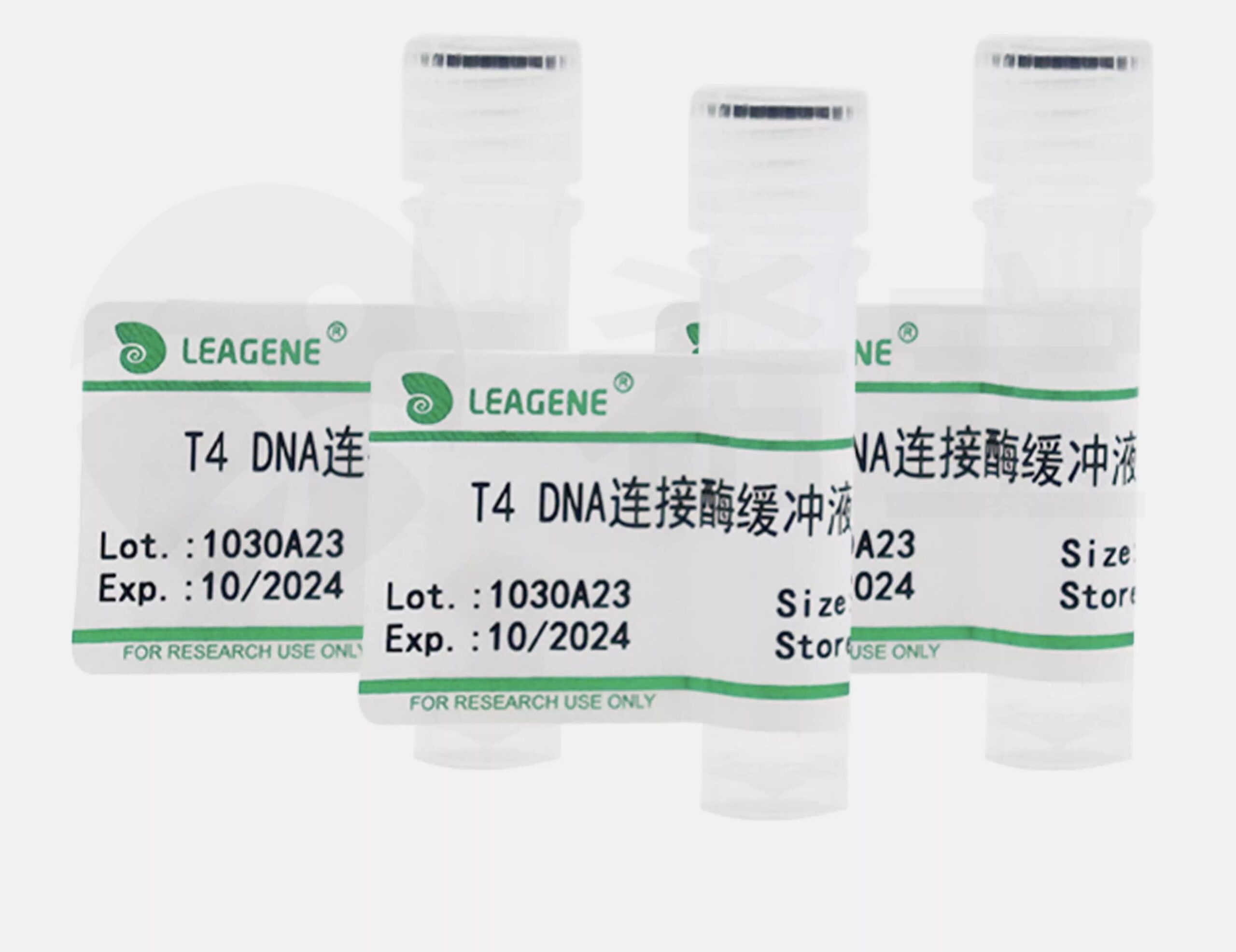
Product Name: T4 DNA Ligase System (10× Buffer & Enzyme)
Product Summary
The T4 DNA Ligase System provides the essential reagents for efficient and reliable DNA ligation, a cornerstone technique in Molecular Biology and Genetic Engineering. The kit includes T4 DNA Ligase, a highly active enzyme, and its optimized 10× Reaction Buffer.
T4 DNA Ligase catalyzes the formation of a phosphodiester bond between adjacent 5′-phosphate and 3′-hydroxyl termini in DNA, effectively joining DNA fragments. This activity is critical for both blunt-end and cohesive-end (sticky-end) ligation, making it indispensable for cloning, library construction, and other DNA manipulation procedures that require the precise assembly of DNA molecules.
Key Features and Specifications
| Feature Category | Specification |
| Enzyme | T4 DNA Ligase (Purified from E. coli expressing the bacteriophage T4 DNA ligase gene) |
| Function | Catalyzes Phosphodiester Bond Formation between DNA fragments |
| Substrates | Both Blunt-End and Cohesive-End (Sticky-End) DNA fragments |
| Buffer Composition (10×) | Proprietary blend including Tris-HCl, MgCl₂, ATP (Adenosine Triphosphate), and Dithiothreitol (DTT) |
| ATP Requirement | ATP-dependent enzyme (ATP is supplied in the 10× buffer) |
| Reaction Temperature | Optimized for efficient ligation (Typically 16°C for overnight or 25°C for shorter incubations) |
| Key Advantage | High Efficiency in joining DNA fragments, robust and reliable for cloning applications. |
Primary Applications
Molecular Cloning:
Plasmid Construction: Fundamental for inserting DNA fragments (e.g., genes, cDNA) into plasmid vectors for gene expression, protein production, or further genetic manipulation.
Gateway Cloning/TOPO Cloning: While specialized kits exist, T4 DNA Ligase is the underlying principle for many ligation-based cloning strategies.
Library Construction:
Genomic and cDNA Library Preparation: Assembling DNA fragments into vectors to create comprehensive libraries for sequencing and screening.
DNA Repair and Synthesis:
Used in in vitro applications requiring the repair of nicks in double-stranded DNA or the circularization of linear DNA fragments.
Sequencing Prep:
Ligation of adapters to DNA fragments during the preparation of libraries for Next-Generation Sequencing (NGS).
Components and Their Roles
T4 DNA Ligase: The enzyme itself, responsible for the catalytic reaction.
ATP (Adenosine Triphosphate): An essential cofactor for T4 DNA Ligase. It provides the energy for the ligation reaction.
MgCl₂: Divalent cations are critical for enzyme activity.
DTT (Dithiothreitol): A reducing agent that helps maintain the stability and activity of the ligase enzyme.
Tris-HCl: Provides buffering capacity to maintain optimal pH for enzyme function.
Ordering and Storage
High Purity: Rigorously tested to be free of contaminating nucleases (DNases, RNases), ensuring the integrity of your DNA fragments.
Storage: Both the enzyme and the buffer should be stored at -20 C to maintain maximum activity over extended periods.